Showing posts with label Commentary. Show all posts

Wednesday, 10 February 2010

Something I didn't know about Google Chrome

I've been using Google Chrome now for quite a while. since I originally downloaded it, Chrome has quickly found it's way to my nerdy heart...and boy have I been rewarded. Although Chrome was amazing when I started using it, there were a few faults. Firstly, there was a lack of add-on support, and secondly, I never quite knew why it sometimes used so many resources. The former was eventually included as a feature ,and I must say that with that feature in particular it beats Firefox hands down. I personally have never had issues with the latter on my desktop, however on my Netbook I am constantly aware of system performance and resources usage. I have never had a problem running Chrome on any of my PC's (that's including my Netbook), but sometimes it's nice to know how the resources are being used.

So, as I was reading about some Google Chrome shortcuts, I came across the "Shift + Esc" shortcut. If you press that, the Google Chrome Task Manager pops up. It's actually a very useful little gimmick. It tells you how much RAM, CPU and Bandwidth is being used by all your open tabs, the browser itself, and all the add-ons. This is handy if you ever need to troubleshoot some performance issues or want to squeeze as much speed out of Chrome as you possible can.

I'm also becoming increasingly fond of the F11 shortcut, which puts Chrome into full screen mode. This is nice if you want to browse without the clutter around.

Final Thought Byte : I never cease to be amazed by Google's innovation. I strongly recommend looking at their list of shortcuts because you'll never know what you'll find.

Tags : Google, Chrome, Task Manager, Firefox, Internet

Monday, 30 November 2009

Your Blog e-mail

Looky here! I got this e-mail a couple of minutes ago :

Hey Blogger - My name is David,


I have been searching the Internet for blogs that match our criteria and I wanted to invite you to become a paid blogger at Blog Distributor. (Please understand that I do not send this invitation to every blogger I come across, nor is this a guaranteed acceptance as we can't do a true review of the blog until it reaches our blog analysts').


Roughly 25% of bloggers are now being paid to write postings on their blogs, that are linked to websites. The value here is that, when a blog posting is linked to a website, that website will get higher rankings in the search engines, such as Google and Yahoo. You can write anything you think about the website, positive or negative.


Here is a link that describes how it all works in a little more detail:


https://www.blogdistributor.com/bloggers.php


Our system is set up so that bloggers can make more money with us than with any other blog-for-pay firm. In short, we are the middle man between you and the advertiser. We match the correct blogs with the correct advertisers, who pay us to do so. And then we pay you, the blogger on behalf of the advertiser. You only take the advertisements that you want and are comfortable with. In no way does this alter the owersship of your blog. You simply get paid to write postings on your blog that you choose to write. You do what you want, when you want. You decide what content to accept or decline.


To submit your blog, go to https://www.blogdistributor.com/bloggers_signup.php


If you have any questions, do visit the FAQ's area of the site: https://www.blogdistributor.com/bloggers_faq.php


If you have more than one blog, you are more than welcome to sign those up as well. If you have any other questions, please contact me at: blogdistributor@hotmail.com. I know some people might be worried, getting some random e-mail, so please do write me if you have any questions or concerns. Also do a search for us on Yahoo or Google and look for reviews.

Thanks,

David

Email – blogdistributor@hotmail.com

Phone - 702-317-4256

To remove yourself, please click here or reply to this e-mail with "unsubscribe" in the subject line.


For any of you who got this e-mail and are looking for an answer, don't trust it. It will not be legit, and even if it is, you won't get any money. It's like doing door to door work for a glazing company where your wages are based on commission. You're better off going to Google or Yahoo directly. And anyway, if you're blogging to make money, get into proper journalism. Nobody reads this shit anyway!

Tags : Blogging

Thursday, 9 July 2009

Google Chrome OS..... hmm

The rumours have finally been confirmed on Google's blog. Google will be releasing their very own Operating System in 2010.

Sounds great, right? Well not really. My first major issue with Chrome OS is that it's open source and that Google is using the same business ethic with Google Wave. Generally speaking, an open source product with huge developer support works well if it doesn't give people the tools to plant viruses. By making the whole operating system open source, Google is practically inviting people to send viruses to everyone.

Putting that major flaw aside, however, leaves us with an interesting prospect. Google will probably release Chrome OS to manufacturers first, just like Microsoft. They will probably target netbooks which means by 2010 we should be able to buy a fully working netbook for about £150. At least, that would be the logical place for Chrome OS. It is essentially a pretty version of Linux with Google's Logo on it, it wasn't built from the ground up. Google Chrome itself wasn't even built from the ground up by Google, it was built using WebKit, an existing browser format.

So, who should Google be aiming for? Well they definitely shouldn't be aiming for me. I play lots of games and use lots of different applications, therefore I am not going to risk huge compatability and performance issues until Chrome OS is fully established. The same goes with Windows 7 really, until that has its first inevitable service pack, I'm not touching it with a barge pole.

Final Thought Byte : Google is starting to play a very dangerous game. It will never take the market away from Microsoft, which has decades of experience and decades of being a fully established and trusted brand. Google is still a search engine to many people, not a software development company. Until Google Chrome and Google Wave make it big, Chrome OS will be a huge mistake.

Tags : Google, Chrome, Windows 7, Microsoft, WebKit, Linux

Tuesday, 16 June 2009

Big Update Day - Xbox Live, Twitter and Apple - June 16th

People all around the world are being subject to service interruptions due to big updates. On the day that the Digital Britain report was released, which promises massive digital upgrades in the coming years in return for a small tax, all the major digital companies in the world are preparing to roll out their new generation technology.

First off is Microsoft's 24 hour Xbox Live update. No update specifics have been completely released, as usual, but we do know this update is all about getting Xbox Live ready for the new features that were announced at E3. If you thought it was cool to have Facebook, Twitter and MSN all on your computer, think again. Microsoft has teamed up with Facebook , Twitter and Sky News to bring all of these services to you directly through your Xbox 360. (MSN is already part of the Xbox Live experience). It seems that Microsoft is extending it's monopoly over access to services, which to many people are a necessity of modern day life.

Microsoft has also extended it's monopoly in terms of Windows 7 and IE8. For some bizarre reason, the EU has said that Microsoft is not allowed to ship IE8 with Windows 7. Obviously Microsoft has complied to this, knowing full well that people need IE8 to actually get hold of any other browser. I highly doubt that Mozilla, Opera, Netscape and Google are going to print CD's of their browsers, an option which Microsoft is doing...and also charging us for it. The EU really has no idea how this stuff works.

Now onto the second big update of June 16th. Following on from the whole social networking thing, Twitter is down for maintenance. Just like Xbox Live, it could be down for up to 24 hours. I expect that a million emo kids will be ripping their collective hair out right now because they can't update people on their suicidal thoughts from the comfort of their iPod.

Which brings us to our next major update. Although it's not technically going to be on the 16th, Apple is finally releasing the iPod Touch 3.0 Update... for $9.99. Which is about £7. I'm not sure what good it will do and I haven't seen anything about Google Street View being packaged in, but we'll see once its all released. Expect a review on it soon.

Final Thought Byte : All the big gaming companies are getting over the post-E3 hype and are starting to implement their promises. The UK Government is also starting to get a grip on the digital world, but as usual my thoughts tend to be rather critical. Some old Lord from somewhere posh will never understand the Internet in it's entirety. I doubt that Gordon Brown even knows what Twitter is. Regardless of this, June is going to be a very hectic month indeed. With E3 at the beginning, updates halfway through and Transformers 2 coming out at the end alongside FUEL on PC...it may just be historical

Tags : Microsoft, Xbox Live, Apple, Twitter, Facebook, Transformers 2

Saturday, 30 May 2009

Google Wave - nuff said

The future of the Internet is nearly here. Google has announced it's biggest product since Google Maps. Essentially Google Wave is a open source mass comunication tool. It mixes all the current forms communication into one single open source site. It will blend e-mail, instant messeging, social networking and open source development. By the time it gets fully released there should be a load of Wave apps out. The only danger is that it will get too swamped like Facebook.

We'll be keeping our views on it hidden until more is released, but it already looks awesome. It's got a huge buzz already and has pushed Microsofts announcement on Bing completely out of the limelight. Some sort of war similar to the Internet Browser war in the 1990s is likely to ensue. I'd be crapping myself if I was Microsoft. They have no hope in hell.

Final Thought Byte : Google has finaly given it's answer to everything. We'll do a review as soon as we can get our hands on it. Watch this space!

Tags : Google Wave, Internet

Wednesday, 6 May 2009

Bureaucracy Pushes Swine Flu

As I had implied in my earlier posts, Swine Flu is not as dangerous as the Media had suggested. And guess what? The whole story has been dropped from the BBC's and Sky News' front page.

So what happened? And why is our Bureaucratic society still pumping out advice leaflets which have come much too late and are completely counter-factual?

The answer to the first question is rather easy. The reason that Swine Flu was dropped as a story is because it doesn't make money anymore. A few days ago it turned out that there were hardly any real cases of Swine Flu. It certainly wasn't a Pandemic. However, instead of the Media companies admitting to blowing the whole thing out of proportion, the Mexican Government was blamed for over-reacting. I don't think it's particularly fair to start blaming the Mexicans for getting it wrong. Since when do we hear out news from Mexico?

The interesting thing is that the 'Economic Downturn' is back in our midst. As soon as the Swine Flu story died, a new fearmongering story about the drop in house prices has burst onto the scene. And for some reason there is also a story about a woman who had a face transplant.... which is pretty cool.

So, if the threat wasn't really there and the Media companies have stopped reporting on it, why are we still getting letters and leaflets through from the Government and our Employers? I recieved a badly photocopied 'Health Information and Advice' leaflet from my University today which states that Swine Flu "has already proved to lead to deaths at a higher rate than usual". Didn't I say that normal Flu kills at least 680 people a day? The Swine Flu death toll hasn't come near that, and it probably wont. And what about the "Catch It! Bin It! Kill It!" thing? Surely it's a bit late considering it's all under control, right?

Final Thought Byte : So what does this show about our society? Well, to start with it shows that our Bureaucratic tendencies are still alive and that the old Bureaucratic Engine is still very hard to stop. Unfortunately, the recent events have also shown us the impact that the Media has on our whole society. It's a real shame that everyone, no matter who they are, are so willing to believe everything they are told on TV.

Tags : Swine Flu, Pandemic, BBC, Sky News, Bureaucracy

Thursday, 30 April 2009

Swine Flu Pandemic

To keep up with the Swine Flu situation, we thought it would be a good idea to have another stab at the media.

As many of you may have seen, there is a ridiculous amount of emphasis on the Pandemic Threat Level and on possible deaths. Just to clarify, Phase 5 means that there is proof that there has been a case of Human-Human viral transfer. What that means is that the Swine Flu is acting like any normal flu virus, except it just comes from pigs. When it comes to actual deaths due to Swine Flu, the number you will see floating around is in the hundreds, especially for Mexico. These are the real numbers released by the World Health Organisation :

Mexico : 26 Confirmed Cases, 7 Deaths
US : 91 Cases, 1 Death
Canada : 13 Cases, No Deaths
United Kingdom : 5 Cases, No Deaths
Spain : 4 Cases, No Deaths
Germany and New Zealand : 3 Cases, No Deaths
Israel : 2 Cases, No Deaths
Austria : 1 Case, No Deaths

(Source : WHO Website)

That comes to a total of 148 Cases and 8 Deaths. Instead of emphasising the amount of cases, the Media has jumped on the gun a little quickly and started publishing numbers of suspected deaths. Their numbers are completely wrong and convey the wrong impression. If you actually read the WHO website, it says that most people recover well from Swine Flu. There are some cases where it can cause pneumonia, but normal flu can do this too. There are lots of elderly people that catch the flu and then develop pneumonia. According to the BBC, between 250,000 and 500,000 people die from normal flu every year. But, they don't put that into the headlines.

Final Thought Byte : I really think that the Media is jumping on the bandwagon a little too quickly. Their suspected death numbers are completely wrong and their advice to people contradicts the WHO. Either they are trying to make a quick buck, or they have got the wrong end of the stick. Yes, Swine Flu is a new virus, but the death toll isn't very big in comparison. Normal flu kills at least 680 people a day anyway. To put every one's mind at rest, please visit the WHO Website.

Tags : Swine Flu, Pandemic, Media, News, Deaths, World Health Organisation

Tuesday, 28 April 2009

Swine Flu hits World Stage

After a relatively small lull in the relentless barrage of fear mongering from the Media, we are hit with the prospect of a new viral pandemic. This time, instead of being Bird Flu, it's Swine Flu.

So before I go into the details of Swine Flu and how dangerous it actually is, lets consider the history of coverage of viral outbreaks. In late 2002 the world was rocked by the emerging threat of the SARS Virus. Generally speaking it emerged from Eastern Asia and it affected thousands of people. For some reason though, SARS began to drop off the Media's Fear List when the Second Gulf War started.

So what about Bird Flu? In late 2004 the news began covering the Bird Flu virus. It was the only thing that actually dominated the News headlines with no room for anything else. So what happened to Bird Flu? Well in 2005 the significant and real threat of terrorism was back.

So is Swine Flu just another story that the Media wants to cover to keep their ratings up? Do people not bother watching the news, or bother reading the news, if nothing bad is happening? I don't think that is the case. People are just as willing to buy a newspaper if it had good news in it, but I guess whoever runs the Media thinks that 'Good News is No News'. (You have to like the little play on words there).

My gut instinct tells me that Swine Flu really isn't as dangerous as the Media is going to make it out to be. It can't be mere coincidence that as soon as things quieten down around the world, a Virus scare will crop up. The Media should stick to real news. Like how is the Iraq war going? We committed to a war which has caused so many deaths and cost so much money, why aren't we hearing anything about it? It's a shame. People are fighting for us and what we stand for, and people are only reading about the Swine Flu.

There is a possibility, though, that Swine Flu is actually a continuation of Bird Flu. According to the BBC, the Swine Flu that is spreading has strains of Bird Flu, Swine Flu and Human Flu, which is why it is able to spread to us. So were the experts right when in 2006 they said that the biggest danger was that Bird Flu would mutate? Have their apocalyptic predictions of a super H5N1 virus come true?

Final Thought Byte : Recent history has shown us that virus' are only covered by the Media if there is a lull in normal news coverage. I'm pretty confident that Swine Flu will be forgotten within a year because something else will have taken it's place. I doubt that the Media knows what it will be and I'm positive we live in countries with freedom of speech, so I doubt it's all a Master Domination Plan. I do think, however, that Media companies, in whichever form they come, want to make profit. And in some ways, the best way to make profit is to make news. It's a shame really, but news is all about the entertainment value.

Tags : Swine Flu, Bird Flu, H5N1, Virus, Media, News

Monday, 27 April 2009

Social Networking Madness!

A couple days ago I heard a news story about how Ashton Kutcher was aiming to be a Twitter millionaire.

So, I thought to myself that it might be worth setting up a Twitter account. My common sense told me that I should experiment with a different blog first. So, by following my common sense, I set up a Twitter account for Rifted Universe, a game that I help design. I then set about using twitterfeed.com to link Blogger and Twitter. This should mean that whenever a Development post is made on the RU blog, it will update the Twitter status. Then, by using twitsig.com it's possible to create a dynamic image that shows your latest Twitter update. You can then put this image anywhere you like.

In addition to this it is possible to show your Twitter updates on your blog (See right). After achieving this uber linkage I decided to do that all for my own blog and then to link it to Facebook too. That means that whenever I do a Status update on Twitter, it will show up on this Blog, on the forums I visit and on Facebook. And whenever I do a new blog post it will show up on the forums, Twitter and on Facebook.

It's stupidly confusing, but hopefully it will pay off somewhere down the line.

Final Thought Byte : If you are thinking about starting a blog you may want to consider creating a Social Networking Web too. It's pretty confusing, but it increases the chance of people stumbling across your blog. Be careful with giving access to your boss though. What you say on the internet certainly affects your future job prospects.

Tags : Ashton Kutcher, Twitter, twitterfeed.com, twitsig.com, dynamic forum signature, Facebook, Social Networking Web, Blogger

Thursday, 23 April 2009

Russian Doctors Find Fir Tree in Patient

Yeah, you read that right. Artyom Sidorkin, 28, from Russia recently underwent an operation to remove what doctors thought was a cancerous tumour. After removing half of Artyom's lungs, the surgeons saw that there was actually a fir tree stuck into the side of his lungs.

No one really knows how it got there because generally speaking trees need light and sufficient nutrients to grow. Considering that the fir tree had roots surrounding blood vessels, it can be safely assumed that the 5cm tree received sufficient nutrients from 
 Artyom's blood to grow. It would be interesting to know if it is possible to grow any plant by only feeding it water, glucose and some other minerals. If it is, we could genetically modify plants to have no leaves or flowers and to only grow fruit. It would certainly make growing plants easier in areas with particularly infertile ground, or maybe we could use it to grow plants in space. As long as a planet had Carbon, Hydrogen and Oxygen, we could grow fruit. Well...only if we could find a way to take atoms from the air and to rearrange them into glucose. Funnily enough, this is exactly what plants do. We could certainly use that to take more CO2 out of the atmosphere and to store it in the form of a super glucose, and therefore save the planet from global warming, from who knows? Artificial Photosynthesis?

Final Thought Byte : On a slightly more political note. People always complain about how bad the NHS is, just be glad you're not in Russia. They cant even tell the difference between cancer and a tree! (Credit goes to my girlfriend for this FTB)

Tags : Artyom Sidorkin, NHS, Russia, Fir Tree, Artificial Photosynthesis

Tuesday, 21 April 2009

Bye Bye Inflation

Finally we have official deflation in the country. Now, in terms of economy and jobs and money, deflation is not really a good thing. It means wages will start being cut and we may even see a drop in the minimum wage if things get really bad.

In the short term however, for at least a couple of months, people will have relatively higher wages and things will cost less. Until contracts get renewed and companies push through wage cuts, the Real Wage Index will be a little higher. Unfortunately this will not last for very long because wage cuts will probably be fairly severe. There are two things that people can do in this situation, they can either spend their extra money and boost the economy by reinvigorating the normal supply and demand processes, or they can save their money for when things get bad. The British government tried to boost consumer spending by cutting the VAT before Christmas. Initially this worked, but due to the extensive media coverage, people are actually less inclined to part with their hard earned cash. Similarly, the Bank of England has also dropped national interest rates to 0.5%. This should, in theory, mean that banks can start lending money to each other. The problem is that a bank may be more inclined to borrow money because the repayment is less, but are they as willing to lend the money to other banks if they make less money on it? The drop in national interest rates is also bad for small business owners and pretty much everyone else. Whatever savings we have are not earning us any money and with people losing their jobs, whatever money they did have stashed away is being used up.

It certainly could be argued that by lowering interest rates, the government was trying to encourage people to spend and borrow instead of to save. However, like before, there is a problem with this. Banks are not willing to let people borrow money at lower interest rates, unless it is a mortgage, which is less risky because banks are guaranteed access to some sort of asset, whether it be monetary or not. The biggest problem with this is that banks end up with 'toxic' assets, which is a nightmare for the housing market. A 'toxic' asset usually comes in the form of property which has been repossessed due to an inability of people to pay off mortgages, which in turn is caused by unemployment. Banks can't really do anything with an empty house, which means that the housing market is being flooded with repossessed houses and flats. However, due to the unusual , lengthy and risky way that repossessed properties have to be handled , and of course due to people not being able to afford mortgages, banks are losing even more money. This is a problem that President Obama is currently trying to solve by pumping lots of money into banks and to encourage them to just get rid of their 'toxic' assets. But if people aren't buying, then banks can’t really sell these ‘toxic’ assets.

The ‘Credit Crunch’ is also very much alive. Even with cuts in national interest rates, credit cards still have huge interest rates because the banks are not confident in the customers ability to pay back the money. Which makes sense considering that unemployment is on the rise because there is less demand for goods and services and keeping people employed just wastes money. But if we’re now entering a period of deflation, surely interest rates on credit cards should drop, right? The problem doesn’t really lie in how much stuff costs but rather the difference between how much stuff costs, and how much people can afford. If prices drop, and wages drop, the ratio will stay relatively the same. What we need, therefore, is a bigger gap between what things cost and what people can afford. This can only be achieved by either letting prices drop and keeping wages the same, or artificially inflate the economy and to increase wages at a higher linear rate. Borrowing money only really works if people don’t need to do it, but rather do it out of choice. The cost of living in the UK is too high and people are being driven to borrow money and ridiculously high interest rates of necessity.  

Sounds confusing, right?

Well it is. It's all very circular and I have certain doubts to whether the government, or any government anywhere, is able to restart any form of normal economic activity. A article by a Prof Lyons from the University of East Anglia suggests that we should temporarily nationalise all banks, reform the economy from within and then when it's all fixed hand it back to the share holders. In theory it's a nice idea, but you can't force the economic machine. Not to mention that the strength of the Pound will drop even further because people will not be willing to invest in an economy which is essentially communist.

So what should we do? If we all started spending money like crazy the economy would do better. The more money that businesses have, the more money they can pay us. It also means that people need to borrow less money in the long term, which means interest rates are put up and banks can start making money again. Which is good for us, because we get more money, spend it on more stuff and the world goes round. But, for this to happen we actually need to give up nearly all our savings. We need to spend everything that we earn on things that we probably don't need. Nationalising banks certainly won't achieve this and it is unfair to expect our governments to take the blame, or for the banks to take the blame. It is actually the media and people who profit from all of this who should take the blame. There are certain bank managers who profit, but at the end of the day they are all being totally ravaged by the media and are being forced to resign.

In historical terms we are entering some very uncertain grounds. Pretty soon people will start saying this is the new 'Great Depression'. I suppose in certain ways it is a 'Great Depression', but it is far from being identical. Our governments are slowly being forced to adopt more liberal, and in some cases socialist, political ideologies to deal with our problems. Had the world economy kept going throughout the US Presidential Election, I doubt that Obama would have felt as secure of imminent victory. It is without doubt that Obama is the best thing that happened to the world since Clinton, however it is worth considering to what we owe this fortune.

Final Thought Byte : At the end of the day, no one really knows what’s going to happen, or what has happened already. It will be decades before historians will be able to look back upon this period and comment on it without some sort of overriding emotion. Certainly it is probably bad practice for me to write this, considering I am studying to be a historian. But, sometimes, there are more important things in life than our chosen profession.

Tags : Banks, Deflation, Economy, Great Depression, Money, Obama, RWI, Toxic Assets, VAT cuts

Saturday, 24 January 2009

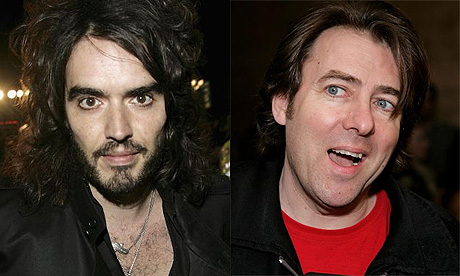
So Ross is back again.

To start off, I want to talk about what Jonathan Ross did in the first place to be banned from presenting his radio and TV programmes on the BBC. In October, Jonathan and Russell Brand had called up the semi-famous Fawlty Towers actor Andrew Sachs. After an alleged 42,000 complaints to the BBC, the media made it look like the two presenters had left 'obscene' messages on Sachs answer phone. What they actually did was phone him up and record the beginning of his answer phone and then recorded their own response. So that puts a hole in the accusation straight away. What they did was risky, but it was meant as a simple joke. Secondly, they were crucified for what they said. On the so-called answer phone messages, Brand and Ross had said that Sachs' daughter had slept with Russell Brand. In actual fact, this is very true. They did sleep together. So it's not like they made anything up. And thirdly, Sachs' daughter , Georgina Baillie, works for some weird Gothic stripper band. So it's not like they made her look any worse.

Personally, I don't really like Russell Brand or Jonathan Ross very much, but I don't think they deserved this. They had enough money to keep going, obviously, but the whole event has shown us how touchy some people can get. I would bet you anything that the 42,000 people that phoned up to complain were either old or pot smoking, prius driving , eco-sensitive dicks.


Final Thought Byte : As a final thought, it is good to see Ross back on our TV screens. But we should really think about what's wrong with our society. We have some major problems that need sorting out, I just hope it doesn't mean voting for the Tories to solve it all.

Tags : Andrew Sachs, BBC, Friday Night, Georgina Baillie, Jonathon Ross, Radio 2, Russell Brand, Social

Wednesday, 13 August 2008

Old baby names really dying out? Not so sure on that...

After reading the BBC report on old baby names dying out, I did a little research into top baby names.

Although the report is probably right about some older names dying out, like Norman or Walter, it forgets to mention that the current top male name Jack has been popular for over 100 hundred years in western society and has been the most popular name in the UK for 14 years.

Chances are, the BBC is probably reacting to the introduction of non-traditional names into the top 20 list. According to government statistics, Mohammed is at number 17 and Muhammad is at 38. To be honest, I doubt that a lot of Caucasian couples are naming their child Mohammed or Muhammad, which means that the BBC is just taking a stab at immigrants.

Now, if the BBC were honest about this irrational fear, fair enough, but they aren't. We all know that throughout History the UK has been the settling place for a lot of immigrants, whether they are from India, Pakistan or Ireland. We also know that after two generations, those immigrants become part of the British culture. Of course that means that non-traditional names become a lot more popular, but that doesn't mean we should get panicky about it. A lot of people in the UK who call themselves "English" rarely originate from the UK completely. Someone always has a Norwegian Aunt or something.

So being English doesn't mean having 10 generations of completely English ancestors, it means being part of the British society and culture. Heck, the basis of English society as a whole is a weird mix of Normans, Vikings and other European cultures. Why start getting protective about our heritage now anyway?

Final Thought Byte : So why should the BBC publish a whole series of reports about the decline in traditional names? Its a fact that things change over time, so get over it.

Tags : Baby names, BBC, Engish Heritage, news

Tuesday, 29 July 2008

Amazing Supermarket Disaster : Aaaahh!

For anyone living within the United Kingdom, inflation has recently become a real problem. Every supermarket is boasting the fact that they are "rolling back prices" , but what are the effects of that on supermarket employees? From very recent personal experience, the damage of super high inflation on a highly competitive market is showing through.

Normally around May, the job market tends to be saturated. If you’re a University student returning home, you’re normally guaranteed a job for the summer. Not this year though. After 8 applications and 3 interviews for jobs that barely met national minimum wage, only one company had the courtesy to tell me that they had considered my application. After two further interviews, the first being a gruelling group selection, and an induction which was focused on teaching new employees the importance of the individual, I started work as a checkout operative in a leading supermarket.

My training for checkouts was minimal at best, but wasn’t really an issue. It was company standard to put all new employees on a 12 week probation period. In normal jobs in offices, this probation is usually 3 to 6 months long, but 12 weeks of training/probation for a supermarket job is a little much.

The first two weeks went pretty quickly and the job seemed relatively easy. However, the first cracks were showing through. The store I worked in was less than 6 months old and was one of the companies most celebrated achievements in the area. Apparently we had built up a good rapport with the community and apparently we offered the most choice compared to our competitors. What they didn’t mention is that the store suffers from broken “travelators” , broken conveyer belts on the tills, broken slam locks for the tills and broken management. It seems that this particular supermarket was achieving inflation busting prices by destroying half the store. They would rather charge a penny less for milk than employ a bloke with a can of oil.

The lack of good management in these stores is what affects employees the most. After three weeks I was already filing a complaint against a night manager for harassment. My normal day manager had “sorted” the problem, but not addressed the issue. The night manager had stopped harassing me, in fact he stopped talking to me full stop, but that only meant he started harassing a colleague. All the official channels were avoided because they could not afford to fire this particular night manager. This again is an example of money before employee safety.

A week after that I had called in sick with a stomach bug. After only taking one day off, I was back to work the next day. My manager had called me over and told me that my probation was being extended by 4 weeks because I took a day off. She had also said that I had to go through HR because apparently a day off sick was cause for concern. As she failed to spell correctly on the HR form ,I asked my manager what I should have done with a stomach bug, her answer was for me to come in to work regardless. Again, it seems supermarkets are more interested in money than in employee safety and customer safety.

I gave my notice in the following Saturday..

Final Thought Byte : Inflation is really starting to hit the UK bad. Petrol prices are stupidly high and food prices even higher. Supermarkets are fighting each other to the death in an attempt to get all the customers. And to the death they shall fight. Supermarkets would rather lower prices than ensure the safety and comfort of customers and employees. People are going to catch onto this soon enough...

Tags : competition, Economy, food prices, Inflation, supermarket, UK, work

Sunday, 27 July 2008

One child policy doesn't apply to Pandas?

Earlier this July, four baby giant pandas were born in China. For a species which has more stuffed toys in its image than actual animals, four pandas in two weeks is pretty good going. Although giant pandas are very very cute and get loads of publicity, I don't think they are worth the trouble. We've all seen the youtube video where the mother panda freaks out as the baby panda sneezes, so why should we bother saving a species that can't even handle a sneeze from its children?

The fact that it's in China means that we should be skeptical to begin with anyway. When was the last time you heard the news quote the Chinese Government as a reliable source? I wouldn't be surprised if they killed one of the twin baby pandas to conform with the famous 'One Child' policy.

I know what you're all thinking: suggesting the murder of a new born panda is brutal. And that's the thing, it would be murder. So what about all those unborn children in China? Or even those babies that "go missing" in families that already have one child? To be fair, there was talk about changing the policy, but it's probably not going to happen. (BBC News Report)

Final Thought Byte : It seems to me that we should spend more time and effort on addressing the human population problem in China rather than the Panda population problem. It's a shame though, that as a Western society we don't get involved unless we're under direct threat or if we can get some money out of it. I guess we'll have to wait until Global Warming starts to fry us....

Tags : BBC, China, news, One Child Policy, Panda, youtube

Friday, 25 July 2008

Open that Valve on the Speaker!

What happens when you stick some water on hot coals? You get Steam.

So what happens when you stick some hot ideas in the hands of the people who made Half Life? You get Steam.

A review on Steam seemed like a pretty good thing to do, considering it is at the forefront of online media distribution. IT also seemed to be a good idea considering the laws being passed throughout the Western hemisphere regarding illegal file sharing.

The other day, the British government helped make a deal between the UK’s biggest ISP’s and the music industries (BBC News Report). The BBC and other bloggers pointed out a few problems with the deals and how pissed off people are going to get. At the very basic level, anyone who downloads any songs illegally is likely to get a letter through the door. The chances of any legal action being taken are probably low, but it seems there is a definite crack-down on downloading music. I expect that the music industry realised that it probably shot itself in the foot, so there is talk about introducing services that allow people to download music for an annual fee. Problem is, no –one really knows what this fee will be. iTunes is a leading distributor of online DRM protected music and the prices on there are ridiculous, I’m never going to use iTunes if I’m perfectly honest.

So where does Steam come in? The attack on illegal music file sharing is only the first phase of a wider crack-down. Game companies are reporting losses on most PC game titles and that means most of them are moving towards consoles. Look at Unreal Tournament 3 for example. The game, which was traditionally a PC only game, was released for both the PC and PS3. A couple months later it was released for the Xbox 360. Although game development companies have more control and power over use of cracked games, they are probably still losing money.

Steam, however, seems to completely fix this problem. The software is full of rock solid security features that protects all the games that are featured. The prices are also pretty good and the weekend deals are a great idea. The fact that you can download demos for most games in one place before buying them and being able to talk to your friends whilst doing the Master levels on Peggle Deluxe makes Steam an all-in-one wonder package. I must have spent about £30 buying games on there already and I don’t have a problem spending more.

If the music industry really is thinking about creating internet based services, they should talk to Valve. People already use Steam for games, so they might as well use it for listening to music. Heck, Valve should just set up its own record label. Many indie software developers use Steam as an easy and cheap platform for releasing their games without having to give a ton of cash to software distributers. Unknown music artists could really use that type of ideology. Most of the music that’s in the in the charts is complete crap anyway, we could really use an incentive to actually pay for music.

Final Thought Byte : Change is in the air when it comes to music, gaming and movies. Everyone is going to start complaining and we all know that governments can’t really stop illegal file sharing. What they need to do is create an incentive for people to actually spend their hard earned cash on music. Steam has done this for games, so they might as well do it for music.

Tags : DRM, file sharing, games, music, Steam, Valve